TL;DR
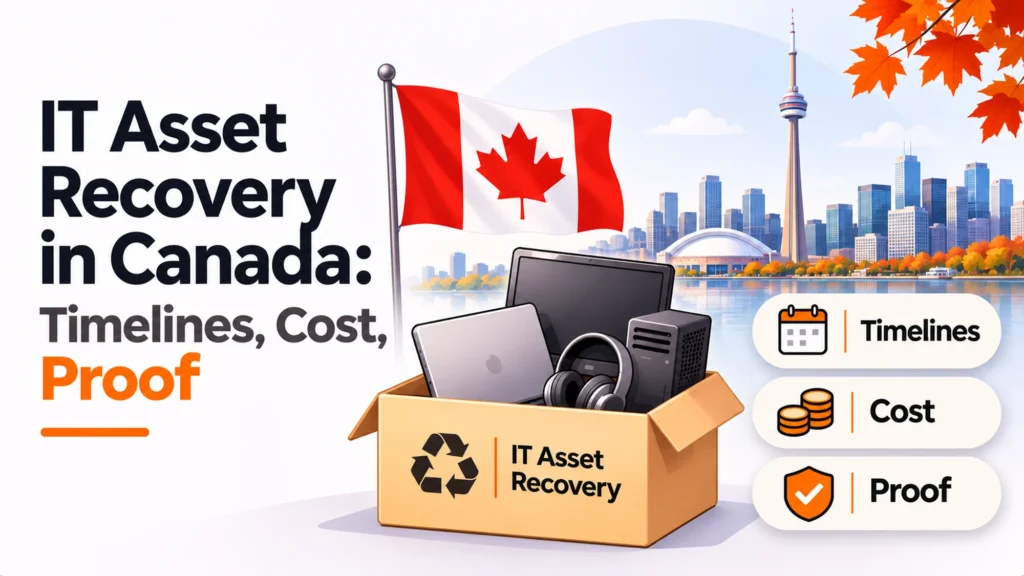
IT asset recovery in Canada looks like a rounding error on a United States process. Same continent, similar couriers, shared language in most of the country. The assumption holds right up to the point a device has to cross the border, which is a different operation from a domestic move no matter how short the distance. The second thing that breaks is geography: a small population spread across an enormous area, with a long tail of addresses no courier reaches quickly.
- Do not treat it as a United States region. Crossing the border is a different operation from a domestic move.
- Keep recovered devices in-country where you can. Redeploying locally avoids the harder movement entirely.
- Courier reach is excellent in the corridor and thin beyond it. Ask about province-level reach.
- Winter is a real scheduling input in parts of the country, not an excuse.
- French-language instructions raise success rates in Quebec. Ask what languages your supplier uses.
- Ask for erasure evidence naming the serial number and which entity issues it.
IT asset recovery in Canada is not a United States region
This article describes operational practice only. It does not state what any customs, tax or employment rule requires, because that differs by country and by circumstance. Take local advice, and confirm shipping specifics with your own carrier.
This is the assumption that causes most of the trouble, and it is easy to make.
Couriers are familiar. Most of the population lives close to the border. Business hours overlap. So a process built for the United States gets pointed north and mostly works, until a device needs to physically move between the two countries.
At that point it is a cross-border movement, and the specifics vary by route and change over time. We are not going to tell you what any authority requires, because that is not something a general article can do reliably. Confirm it with your carrier and take local advice.
What we can tell you is the design that avoids the question. Keep the device in the country it was collected in, and reissue it there.
Vendors reinforce the distinction, incidentally. In published region models of the kind Workwize uses, Canada and the United States usually sit inside one North America region, which is convenient for pricing and tells you nothing about the operational difference.
Geography, and the long tail of addresses
The second thing that breaks a borrowed process is distance.
A large majority of the population lives within a relatively narrow band near the southern border, concentrated around a handful of metropolitan areas. Courier density there is genuinely good.
Beyond it the picture changes quickly, and remote work has put employees in places that no supplier’s country-level answer describes. A northern or rural address can behave nothing like a downtown Toronto condominium, on both timeline and cost.
Weather belongs in the plan rather than in the excuses. In parts of the country, winter affects road access and collection scheduling for months at a time. A collection booked for February in a remote area is a different proposition from the same booking in July.
So ask for reach by province, and ask what happens when an address falls outside normal service. The honest answers are a longer timeline, a drop-off point, or a partner handoff.
Language, and the proof you need back
Two operational details that get skipped.
Language. In Quebec, instructions and labels in French raise the success rate. This is not a compliance point in this article and we are not making one. It is a practical observation: people respond better to instructions in the language they work in, and a lower response rate reads as non-cooperation when it is actually a process choice.
Proof. Ask what comes back per device, and insist that it names the serial number. NIST Special Publication 800-88 is the standard you will be asked about when somebody wants to know how a machine was erased. Ask whether the wipe happens at collection, at a regional facility or at a subcontractor, because that determines whose certificate you are holding.
For hardware that is genuinely finished, the EPA list of certified electronics recyclers and the R2 standard for responsible recycling are the references a disposal claim gets measured against. Ask which recycler and ask for the evidence per serial.
Both of these are cheaper to settle in the contract than to chase afterwards.
The design that works: keep it in country
Four steps, and they remove the hardest part of the problem rather than solving it.
- Collect to an in-country point, not to your head office in another country.
- Store there, at a published rate per device per month, with a known minimum term.
- Erase and record against the serial number at that point, so the register closes while the information is fresh.
- Reissue to your next hire in the same country, which avoids the border movement entirely.
The economics are straightforward. Two cross-border movements of a two year old laptop can cost more than the machine is worth, and they are slower.
If you hire here even occasionally, in-country storage pays for itself quickly. Our laptop storage guide works through the per-month arithmetic, and our DDP against DAP note covers responsibility allocation for the shipments you cannot avoid.
Where the device genuinely must leave the country, confirm the route with your carrier and plan a longer timeline than the domestic equivalent.
Choosing a supplier for this market
Disclosure: RemoAsset, named below, is owned by the same people who publish this site. Its published coverage and its limits are both stated. PeopleOpsHQ takes no vendor money and sells no placements.
Six questions, and the first three are the ones people forget.
- What is your reach by province, and what happens beyond normal service areas?
- Can you store in-country and reissue without the device leaving Canada?
- What languages do collection instructions go out in?
- What does a failed first attempt cost, and who rebooks it?
- What erasure evidence comes back, naming the serial number, and who issues it?
- How do winter conditions affect your stated timelines in the areas where we have people?
That last question tells you quickly whether a supplier actually operates here or resells somebody who does.
RemoAsset publishes Canada in its retrieval coverage list and prints a subscription from 1,499 dollars a year, with courier pickup, chain of custody and local storage carrying redeploy, recycle and resale pathways.
Where RemoAsset struggles. It publishes no per device rate, so a company with four leavers a year cannot size it from the website and has to ask. Its published retrieval list runs to ten countries while its procurement coverage is quoted far wider, and its own pricing page states those two figures inconsistently. It is also our product, so read the coverage as disclosed rather than independently verified.
The decision table
| Situation | Scale | Setup | Primary pain | Recommended starting point |
|---|---|---|---|---|
| A handful of people near the border | Under 25 locally | Courier account | Low volume, occasional | Collect locally, store with a local partner |
| Hiring here continuously | 25 plus locally | Shipping both ways | Two border movements per cycle | In-country storage and local reissue |
| Process copied from the United States | Any | One North America playbook | Border treated as domestic | Split the country-specific steps out |
| Employees outside metro areas | Any | Distributed addresses | Reach and timeline | Ask province-level reach, plan longer |
| People in Quebec | Any | English-only comms | Lower response rate | Ask for French-language instructions |
| Device must leave the country | Any | Head office elsewhere | Cross-border specifics | Confirm the route with your carrier first |
What getting this wrong costs
The first cost is the avoidable border movement. Shipping a used laptop out and a replacement back in is two of the most expensive operations available, chosen by default because it feels like recovering an asset.
The second is timeline drift on the long tail. A collection from a remote address scheduled as if it were a city pickup slips, and nobody finds out until somebody chases it.
The third is the proof you cannot produce. Erasure evidence that does not name the serial number is close to worthless in a review, and so is a disposal claim with no named recycler behind it.
The fourth is the one that compounds. Every shipment sits on top of carrier rules for lithium batteries, and IATA guidance on shipping lithium batteries is the reference your carrier works to. A supplier who absorbs that is buying you something real.
If somebody asked how many company laptops are currently sitting in Canadian homes after people left, how long would it take you to find out?
Setting it up properly
Separate your Canadian steps from your United States ones in whatever document holds your process. That single change prevents most of the errors in this article, because it forces somebody to answer the border question once rather than per leaver.
Pull employee locations by province before you talk to suppliers, so the reach conversation is about your addresses rather than a map.
Set an in-country storage and reissue default, and make shipping out the exception that needs a reason.
Then pick a supplier that names Canada in its collection markets rather than inside a North America claim, with stated pickup and chain of custody.
Our guide to reading coverage claims covers how to test one properly.
Read our international shipping guide, or our retrieval turnaround guide.
Frequently asked questions
Can we run IT asset recovery in Canada on our United States process?
Partly, and the part that does not transfer is the expensive one. Couriers are familiar and most of the population lives near the border, so domestic collection feels similar. The moment a device has to move between the two countries it is a cross-border movement with specifics that vary by route and change over time. Confirm those with your carrier and design to avoid them where you can.
Should recovered laptops stay in the country?
Usually yes. Collect to an in-country point, store there, erase and record against the serial number, then reissue to your next local hire. That removes two cross-border movements per cycle, and for a two year old machine those movements can cost more than the device is worth. Make shipping out the exception that needs a stated reason rather than the default.
How much does courier reach vary across the country?
A lot. Density is good in the metropolitan areas near the southern border where most of the population lives, and it thins quickly beyond them. Remote work has placed employees well outside those areas, so ask for reach by province and ask what happens when an address falls outside normal service. Expect a longer timeline, a drop-off point or a partner handoff.
Does winter really affect collections?
In parts of the country, yes, and it belongs in the plan rather than in the apologies. Road access and scheduling in remote areas are materially different for several months of the year, so a February collection from a rural address is not the same proposition as the same booking in July. Ask suppliers directly how their stated timelines change in the regions where you have people.
Do we need French-language collection instructions?
Ask your supplier what languages it uses, because response rates are better when instructions arrive in the language somebody works in, and Quebec is a substantial part of this market. We are making a practical point rather than a compliance one. A lower response rate caused by English-only instructions tends to be recorded as non-cooperation, which hides the real cause.
What proof should come back for each device?
Erasure evidence naming the serial number and stating the standard used, plus the identity of whoever performed it. Ask whether the wipe happens at collection, at a regional facility or at a subcontractor, because that tells you whose certificate you are relying on. For hardware that is finished, ask the same about the recycler and get the disposal evidence per serial.
Is a specialist supplier worth it for a small Canadian headcount?
If you have a handful of people and rare departures, a local courier plus sent packaging and a named owner for the register will do. A specialist earns its place once you are hiring here continuously, because in-country storage and local reissue remove the border movement from every cycle. Price storage per device per month and compare it against two shipments.
PeopleOpsHQ publishes independent guidance for IT and People teams at remote and hybrid companies. We sell nothing and we take no vendor money.