TL;DR
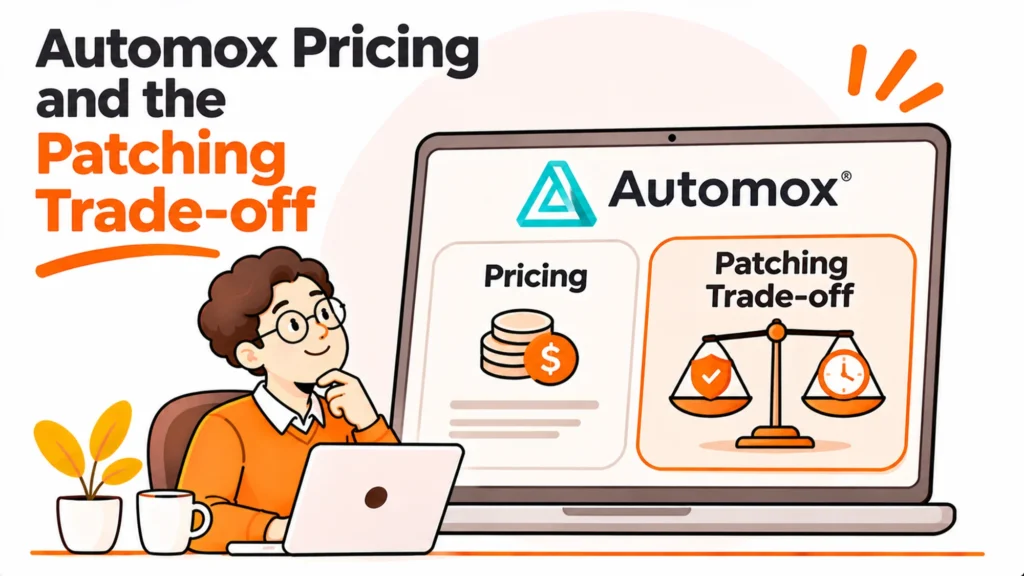
Automox pricing publishes exactly one figure and routes everything else to sales. That one figure is unusually clear, which makes the page more useful than most in this category, as long as you can tell it apart from the eight other dollar amounts a scrape will pull off the same page.
- One published plan: $1 per endpoint per month, annual.
- The other two tiers are Custom Pricing.
- A grep of the page returns eight figures that are not prices.
- Per endpoint means the bill tracks hardware.
- Patching is one job, not fleet management.
- Budget the cadence and the exceptions, not the licence.
One number, and it is a clear one
Worth giving credit where it is due, because most of this category publishes nothing.
The Patch OS plan is listed at $1 per endpoint per month, with an annual commitment. The unit and the term sit next to the figure, which is exactly what a buyer needs and more than several competitors manage.
The page does not print a currency code beside it, which is a small thing and worth noting if you are budgeting in anything other than dollars.
Automate Essentials and Automate Enterprise both show Custom Pricing with a note that volume discounting is available and an invitation to talk to sales. So the published price covers the entry product only, and the capability most buyers eventually want sits behind a conversation.
What that structure tells you
The entry tier is priced to be easy to say yes to. The decision that costs money is the upgrade, and you cannot model it from the website, so ask for both numbers in the first call rather than the one you are being shown.
The eight figures that are not prices
This page is an unusually good example of why automated price extraction fails.
A plain currency search of the downloaded page returns $11, $12, $13, $14, $28, $34, $35 and $36. None of them is a plan price. They sit inside scripts and have nothing to do with what you would pay.
The visible page carries several more numbers that are also not prices. “Save 25%” is a discount for annual billing. “200+ device licenses” is a volume threshold for custom plans. “633+ Third-Party Patching Titles” counts supported software. “4.7 stars” is a Gartner Peer Insights rating. “5 support tickets every month” is a limit on a support tier.
| Figure on the page | What it actually is |
|---|---|
| $1 per endpoint/month | The one real plan price |
| 25% | Annual billing discount |
| 200+ | Device threshold for custom plans |
| 633+ | Count of patchable software titles |
| 4.7 | A review rating |
| 5 | Support tickets per month |
If a comparison article quotes you a per-endpoint figure for this vendor that is not the one above, it was generated rather than read.
Per endpoint is the basis that matters
And it is the one that makes this cheap or expensive depending on your shape.
Per endpoint means the bill tracks hardware. Every laptop, desktop and server you manage is a line. A company with more devices than people pays more than its headcount suggests; a company with shared machines pays less.
Compare that against the other bases in this category. Identity platforms and Microsoft price per user, so extra devices are free. Some MSP tools price per technician, so endpoints are unlimited. An Apple specialist prices per device with a licence minimum.
At a low per-endpoint rate the basis matters less than usual, which is the real attraction here: on most fleets the arithmetic stays small enough that the structure does not dominate the decision. That stops being true at the Custom tiers, where you cannot do the arithmetic at all.
endpoint management software covers how the category splits by billing basis, which is the comparison worth building first.
Patching is one job
The honest boundary, and it is narrower than fleet management.
The entry product does operating system patching. Third party application patching, configuration enforcement, scripting and the wider automation sit in the tiers you cannot price from the page.
That is a legitimate way to build a product and it has a consequence for buyers: if you are comparing this against a full endpoint management suite, you are not comparing like with like at the published price.
Decide which job you are buying. If patching is genuinely the gap, an entry tier that does patching well is a good purchase. If you want one tool for configuration, inventory, deployment and patching, price the upper tiers before deciding, or you will discover the real number after the first renewal.
CISA’s known exploited vulnerabilities catalogue is the reference that should shape that decision, because it distinguishes what is actually being exploited from what is merely outstanding, and the first list is the one a patch policy has to keep up with.
What patching really costs
Three costs sit outside the per-endpoint figure and routinely exceed it.
Testing. Somebody has to confirm an update does not break the application your business runs on. That is a recurring task, not a setup task.
Scheduling around people. Reboots during a working day are an incident of their own, and a distributed team has no quiet hour everyone shares.
The machines that did not take it. Off, offline, on leave, or not enrolled. Chasing these is manual on every tool in the category and it is where the time actually goes.
That third group is also a measure worth watching: patch coverage reported as a share of enrolled devices flatters you if enrollment itself is incomplete. our guide to IT asset management covers getting the denominator honest.
the NIST Cybersecurity Framework is a sensible frame if you need to show how patch cadence fits alongside your other controls rather than as a standalone number.
What no patching tool reaches
Three gaps, physical rather than technical, and they recur across every vendor in this batch.
A device that never connects cannot be patched or reported on. In a distributed team that set grows quietly, and it grows fastest after departures.
A device nobody can locate is a custody problem. RemoAsset’s laptop lifecycle management covers that side, including recovering hardware from people who have already left.
A device at end of life needs disposal evidence rather than an update. the EPA on electronics and batteries management covers handling and NIST Special Publication 800-88 on media sanitization is the sanitization standard the paperwork is judged against.
CISA and the Secure Our World guidance is a reasonable baseline for the practices that sit around all of this, none of which any single licence delivers on its own.
How to price it for your own fleet
Four steps, none of which needs a sales call to start.
Count endpoints, not people, and include servers, because they are endpoints here and they are the ones omitted from the first estimate.
Multiply by the published rate for the entry tier and treat that as your floor rather than your answer.
Ask for the Custom tiers in writing, with the same unit and term, before you commit to the entry one. The upgrade path is the real decision.
Add the operational cost, meaning the person who runs the cadence, which is usually larger than the licence on a fleet of any size.
Then compare against one tool that prices per user and one that prices per technician, using your own counts. RMM software covers who sits where. If the three answers are close, pick on capability; if they are not, the basis has made the decision for you and it is worth knowing that it did.
The question to ask on the call
What does the entry tier not do that we will want in a year? A vendor with a straight answer is describing an upgrade path. One that says it does everything is describing a sale.
Patching reaches devices that connect. RemoAsset reaches the ones that do not, across 80+ countries. See RemoAsset’s laptop lifecycle management or RemoAsset’s pricing.
Frequently asked questions
What does automox pricing actually publish?
Exactly one plan price. The Patch OS plan is listed at $1 per endpoint per month with an annual commitment, and the unit and term sit next to the figure, which is more than several competitors manage. No currency code is printed beside it. Automate Essentials and Automate Enterprise both show Custom Pricing with a note that volume discounting is available and an invitation to talk to sales.
Which figures on the page should I ignore?
Most of them. A plain currency search of the downloaded page returns $11, $12, $13, $14, $28, $34, $35 and $36, none of which is a plan price, since they sit inside scripts. The visible page adds more: save 25% is an annual discount, 200+ device licenses is a volume threshold, 633+ counts patchable software titles, 4.7 stars is a review rating, and 5 is a monthly support ticket limit.
What does per endpoint mean for my bill?
That it tracks hardware rather than headcount. Every laptop, desktop and server you manage is a line, so a company with more devices than people pays more than its headcount suggests. Compare that against identity platforms and Microsoft, which price per user so extra devices are free, and some MSP tools, which price per technician so endpoints are unlimited.
Is this a full endpoint management tool?
No, and the boundary is narrower than fleet management. The entry product does operating system patching, while third party application patching, configuration enforcement, scripting and wider automation sit in the tiers you cannot price from the page. If you are comparing it against a full suite, you are not comparing like with like at the published price.
What does patching really cost?
Three things outside the licence that routinely exceed it. Testing, since somebody must confirm an update does not break the application your business runs on, which recurs rather than being setup. Scheduling around people, because reboots during a working day are an incident and a distributed team shares no quiet hour. And chasing the machines that did not take it, which is manual on every tool.
What does no patching tool reach?
Three gaps, physical rather than technical. A device that never connects cannot be patched or reported on, and that set grows quietly, fastest after departures. A device nobody can locate is a custody problem rather than a patching one. And a device at end of life needs disposal evidence rather than an update, judged against a recognised sanitization standard.
How should I price it for my fleet?
Four steps. Count endpoints rather than people, including servers, which are the ones omitted from the first estimate. Multiply by the published entry rate and treat that as a floor rather than an answer. Ask for the Custom tiers in writing with the same unit and term before committing, since the upgrade is the real decision. And add the person who runs the cadence.
PeopleOpsHQ covers remote IT operations. RemoAsset procures, deploys and retrieves laptops in 80+ countries. RemoAsset’s laptop procurement.