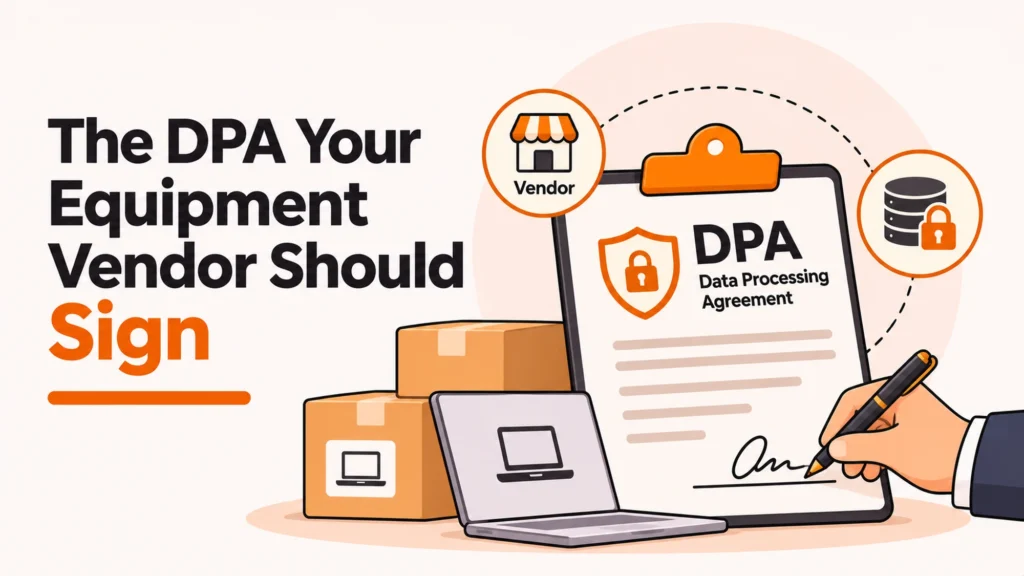
A data processing agreement equipment vendor arrangement is the one most onboarding processes skip, because the risk looks physical rather than digital. A partner delivering laptops holds your employees’ home addresses, which is personal data whatever the service looks like.
TL;DR
- Home addresses are the sensitive part, not the hardware.
- Subprocessors matter most. Local couriers do the last mile.
- Name the countries. Device movement moves data with it.
- Wipe certificates link a device to a person. Cover them.
- Collection reasons can reveal that somebody has left.
- Exit terms have to move data and hardware together.
When this is lighter than you think
Four situations, and the first two need very little.
One office, deliveries to the building. No home addresses leave your organisation. A standard supplier agreement is proportionate.
Occasional domestic shipments. A courier account where you enter the address yourself. The carrier’s own terms usually cover the processing adequately.
A managed service holding your people’s details. The vendor now keeps a list of who works for you and where they live. This is where a proper agreement earns its place.
Multi-country, with storage and wiping. Subprocessors in several markets, transfers across borders, and records tying devices to individuals. All of it needs naming.
Why the data processing agreement equipment vendor case gets missed
Vendor review processes are built around software. The questions assume a system, a login and a database, and they are asked whenever somebody buys a tool. A logistics partner does not look like that, so it enters through procurement rather than through security and nobody runs the data questions at all.
The second reason is that the data involved seems mundane. A name and an address are not a medical record. But a home address is categorically different from a work email, and a list of them for your whole remote team is a more sensitive dataset than most people pause to consider.
There is a detail that makes it sharper. A collection request usually implies that somebody is leaving, so the vendor’s job queue is also a record of your departures, sometimes before they are announced internally. That is information about individuals, inferred rather than supplied.
Guidance for organisations on what these agreements must contain is published by regulators including the Information Commissioner’s Office, and the privacy management extension in ISO/IEC 27701 treats processor obligations the same way whether the service is digital or physical. Neither carves out couriers.
The seven clauses that matter here
- Scope and purpose. Exactly what data, for what, with no general permission to use it otherwise.
- Subprocessors. A current list, notification of changes, a route to object, and flow down of the same terms. The most important clause in a logistics agreement.
- International transfers. The countries named, with the lawful mechanism stated rather than assumed.
- Security measures. Concrete ones, including who can see the address list and how collection photographs are handled.
- Retention and deletion. How long addresses and job records are kept after a movement completes.
- Breach notification. A timeframe in hours, and what you are told, because you inherit the obligation to act.
- Exit. What is returned, what is deleted, and when, aligned with the physical handover of any stored hardware.
Seven clauses. The second and the seventh are the ones that separate a logistics agreement from a software one.
One clause deserves more attention than it usually gets, and it is the one about what the courier does at the door. Several logistics operators photograph a collection as proof it happened, which is reasonable and useful. That photograph is taken at somebody’s home, frequently includes the doorway and sometimes the person, and it is retained somewhere. Nobody objects to the practice once it is explained; the problem is that it is almost never explained, so it sits outside the agreement entirely and outside whatever you told your staff about how collections work.
The same applies to the notes field on a job. A courier recording that a recipient was unavailable, or that a neighbour took the parcel, is writing about identifiable people in a system you do not control. These are small records, they accumulate, and a retention clause that mentions only addresses leaves them untouched.
Five questions to ask the vendor
Who is your subprocessor in each of my markets? Ask for the list, not an assurance that one exists.
Where is the address data stored? The answer frequently involves more countries than the service does.
How long do you keep a home address after a collection? A specific period, or the default is forever.
Do your couriers photograph at the door? If so, that imagery is personal data too and needs covering.
What do we get back at exit? The address records, the wipe certificates, and the device list, in a usable format.
How teams handle it, and the trade-offs
Rely on the vendor’s standard terms. Best for speed and fine for a low-risk arrangement. It struggles on subprocessors and exit, which standard templates cover thinly because those clauses favour the customer.
Your own agreement, imposed. Best for consistency across suppliers and for your own audit position. It struggles on negotiation time, and a software-shaped template fits a courier badly without editing.
Minimise what the vendor receives. Best control available, since data not shared needs no agreement. It struggles against the service itself, because delivering to a home requires the address.
Route everything via your own entity. Best for keeping addresses internal where you have local presence. It struggles on coverage, as it only works in markets where you have an office.
One vendor instead of several. Disclosure: RemoAsset is owned by the same people who publish this site. It handles procurement, delivery, retrieval, storage and wiping across 80 or more countries, so one agreement replaces several regional ones. Where it struggles: consolidation concentrates the data in one place, which makes the subprocessor list and the security terms more important rather than less.
The decision table
| Situation | Scale | Setup | Primary pain | Recommended starting point |
|---|---|---|---|---|
| Deliveries to an office | Any | One site | No personal data shared | Standard supplier terms |
| Occasional courier use | Under 50 | No IT owner | Low exposure | Carrier’s own terms |
| Managed service, home delivery | 50 plus | One owner | Addresses held externally | A proper agreement |
| Several countries | 100 plus | IT team | Subprocessors unknown | Demand the list |
| Vendor stores devices | Any | Any | Exit moves both | Align data and physical exit |
| Customer audits your chain | Any | Security owner | Logistics not reviewed | Bring it into vendor review |
What the missing agreement costs
The first cost appears during somebody else’s audit. A customer reviewing your supply chain asks for your processor agreements, and the logistics partner holding every employee home address turns out not to have one. The gap is not the risk itself; it is that nobody had considered the category.
The second is the subprocessor you cannot name. Asked who physically collected a laptop in a given market, a company relying on standard terms often cannot say, because the chain was never disclosed and never had to be.
The third is retention nobody set. Address lists held indefinitely by a vendor, long after those people left your company, because no clause said otherwise and no one asked. The data is accurate, which is part of the problem.
The fourth is the breach you hear about late. Without a stated notification window you learn on the vendor’s timetable, and your own obligations run on a clock that started earlier.
So the question is not whether your equipment vendor seems trustworthy. It is whether you could name, today, the company that knocked on your last leaver’s door.
The exit covers two things at once
Leaving a software vendor means exporting data and revoking access. Leaving an equipment vendor means that plus physically moving whatever they hold, and the two have to be sequenced.
If the data terms say addresses are deleted within thirty days, but the hardware handover takes three months, the vendor cannot complete the collections they still owe you. Written separately, the two clauses contradict each other, and nobody notices until the exit begins.
Three signals say yours are not aligned. Your agreement names no handover period for stored devices. It does not say who pays to move them. And the deletion timetable was written without reference to the physical exit at all.
It is worth checking before renewal, while there is no pressure on either side. Seeing how stored devices are recorded and released gives you a benchmark for the list you should expect to receive on the way out.
Related reading
- IT due diligence
- Exiting an equipment platform
- SOC 2 for remote companies
- The certificate of data destruction
- Comparing country coverage
Frequently Asked Questions
Does a logistics vendor really need one?
If they hold your employees’ names, home addresses and phone numbers in order to deliver and collect, they are handling personal data on your behalf. The physical nature of the service does not change that, and it is the main reason this category gets missed during vendor onboarding.
What personal data does an equipment vendor see?
Typically names, home addresses, phone numbers, delivery times and sometimes the reason for a collection, which can imply that somebody has left. For wiping they also hold device identifiers tied to an individual. That set is small and sensitive, because a home address is not a work detail.
Which clauses matter most here?
Scope and purpose, subprocessors, international transfers, retention and deletion, security measures, breach notification timing, and what happens at the end. Subprocessors matter more than usual in logistics, because local couriers in each market are almost always involved.
Why do subprocessors matter so much?
A global logistics service rarely operates its own fleet in every market, so the courier knocking on an employee’s door often works for somebody else. Your agreement should require a current list, a route to object, and flow down of the same obligations, or your controls stop at the first subcontract.
What about international transfers?
Moving devices across borders usually means moving the associated personal data too, and the lawful basis for that differs by jurisdiction. Take advice on your own position rather than relying on a vendor’s template, and make sure the agreement actually names the countries involved.
Should it cover the wipe evidence?
Yes, because the certificate links a device to a person and is therefore a record about an individual. Say how long the vendor keeps it, what format you receive, and that it survives the end of the contract, since you will need it after the relationship ends.
What happens to data when we leave the vendor?
The agreement should say what is returned, what is deleted and when, including the address records and any imagery from collections. For a vendor also holding your hardware, pair those terms with the physical exit arrangements, because leaving means moving both at once.