TL;DR
A first week without a laptop is usually treated as an inconvenience and costed as a few idle days. The larger cost is what the person does instead, which is almost always working on their own machine. That puts company data on a device nobody has seen, with no record it happened, and the arrangement tends to continue.
- The idle days are the smallest cost and the only one anybody counts.
- People work anyway, on their own machine, which is the real exposure.
- The unmanaged period is never documented, so it cannot be remediated.
- It is a measurement failure: dashboards report onboarding complete.
- The fix is upstream: start equipment at offer acceptance.
- If it is unavoidable, limit access and write down the dates.
What actually happens
Nobody spends a first week without a laptop sitting and waiting. That is the thing most plans assume and it is never true.
Somebody starts on Monday, the machine has not arrived, and the manager is reasonable about it. So the new starter uses their own laptop for a few days. They sign into email, join calls, open shared documents and start doing the job they were hired for.
It works. That is the problem. Because it works, nobody treats it as an incident, nobody writes it down, and there is no trigger to stop it when the company machine eventually arrives. Plenty of people keep using their own device for weeks afterwards simply because it is already set up.
So the honest description is not that somebody lost a week. It is that your company operated with an unmanaged device inside it for an undefined period that nobody recorded.
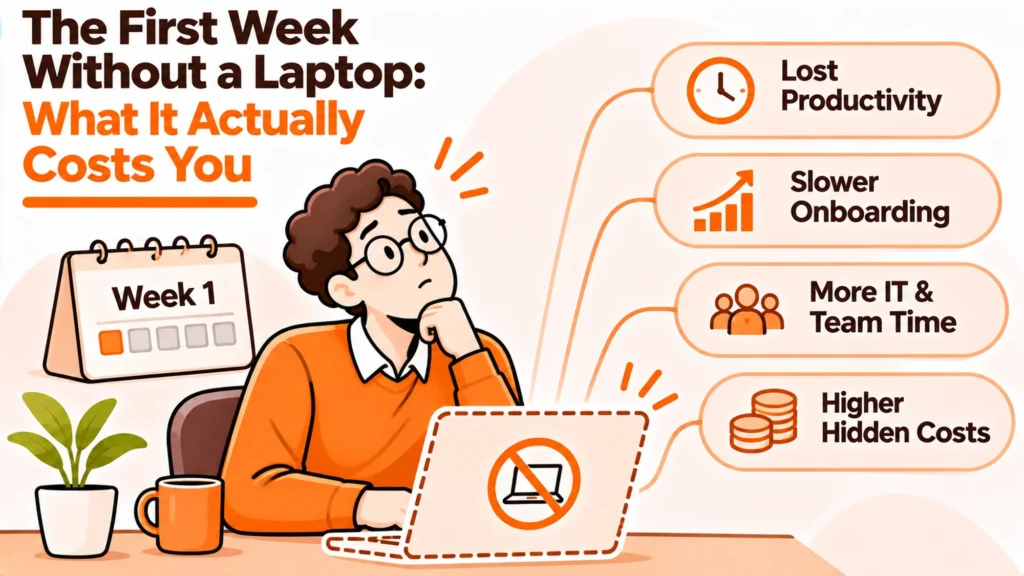
The four costs, smallest first
Idle time. Real, easy to calculate and the only one that gets quoted. A few days of salary for somebody who cannot do the job they were hired for.
Slower ramp. Less visible. The first week sets habits and relationships, and spending it half equipped delays the point at which somebody is genuinely useful by more than the days lost.
The unmanaged period. Company data on a personal device with no encryption guarantee, no managed updates, no remote wipe and no record. This is the cost that turns into a problem later rather than now.
The honesty problem. When a customer security questionnaire asks whether company data has ever been on unmanaged devices, the accurate answer for most companies is yes, repeatedly, and nobody knows for how long. That is uncomfortable to write down.
Notice the pattern. The costs get larger as they get less visible, which is exactly why organisations budget against the first one.
Why it keeps happening
Three causes, and none of them is carelessness.
The process starts too late
Equipment is triggered at contract signature because that is when the address is confirmed. But procurement does not need an address, only delivery does. Starting at offer acceptance decouples them and removes most of the delay.
Nobody owns the sequence
Recruiting knows the start date, HR knows the address, IT knows the build, finance approves the spend. Four functions, one outcome, no owner. It works until somebody is away.
The measurement says everything is fine
Onboarding systems report task completion. Ship laptop gets ticked when somebody orders it. The dashboard shows green while three people are working on their own machines, so there is no signal that anything needs fixing.
That third one is why the problem persists in organisations that are otherwise well run. You cannot fix what your instruments say is working.
If it is genuinely unavoidable
Sometimes it is. A machine fails in transit, somebody starts at short notice, a market has no stock. Four things make it survivable rather than invisible.
Decide explicitly, in writing. Somebody with authority says this person will work on a personal device from this date until that date. A decision, not a drift.
Limit what can be reached. Restrict access from unmanaged devices to the minimum that lets them do something useful, and implement the restriction rather than stating it.
Record the dates. Start and end, against the person, somewhere findable. This is the single thing that converts an exposure you cannot describe into one you can.
Set an end trigger. When the company machine arrives, somebody confirms the personal device is no longer being used for work. Without this the arrangement continues indefinitely because it is already set up.
None of that makes it good. It makes it a known, bounded, documented exception rather than a gap nobody can characterise two years later.
There is a practical limit worth knowing. Once work has happened on a personal device, you have no route to erase it. NIST Special Publication 800-88 sets out the recognised approaches to media sanitization, and they all assume you control the hardware, which here you do not. The same applies at the other end of the cycle, where the EPA list of certified electronics recyclers only helps for machines that actually reach a disposal route. That asymmetry is the reason the unmanaged period matters more than the idle days.
Fixing it upstream
Disclosure: RemoAsset, named below, is owned by the same people who publish this site. It is described with its limitations stated, on the same terms as every other supplier. PeopleOpsHQ takes no vendor money and sells no placements.
Almost all of this is prevented by moving one trigger.
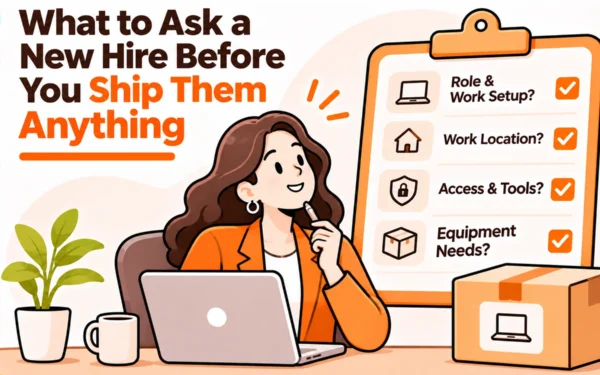
Start at offer acceptance. Decide the build, place the order and send the questionnaire. You do not need a confirmed address to buy a laptop. Confirm the address two weeks out and deliver against it.
Image and enrol a week early. Not the day before. A week gives room for something to be wrong, which it periodically is.
Hold stock where you hire. If your plan is five people a month, having five imaged machines ready removes the lead time from the critical path entirely.
Measure time to productive, from offer accepted to working on a company machine, rather than task completion. It is the number that exposes this.
Where people are in markets you have no presence in, lead times are the binding constraint and no process change fixes them. Suppliers including Workwize, Firstbase, Fleet, Allwhere, GroWrk and Esevel hold stock locally. RemoAsset publishes a subscription from 1,499 dollars a year, states coverage of 80 or more countries, and handles sourcing and delivery to the person’s address with stock held between hires.
Where it struggles. It will not fix a process that starts too late. If your trigger is contract signature, a supplier with local stock shortens one segment of a chain that is still sequential. It also publishes no per device rate, so small teams cannot model it from the published subscription pricing without asking.
The decision table
| Situation | Scale | Setup | Primary pain | Recommended starting point |
|---|---|---|---|---|
| Occasional late machine | Any | Trigger at contract | A few days lost | Move the trigger to offer acceptance |
| Happens most months | 20 plus | Order per person | Lead time on the critical path | Hold imaged stock against the hiring plan |
| Dashboard says all green | Any | Task based reporting | No signal anything is wrong | Measure time to productive and report the distribution |
| New market, no stock | Any | Shipping from a hub | Weeks of lead time | Buy locally, or use a supplier with in country stock |
| Already happening now | Any | People on own devices | Undocumented exposure | Write down the dates, limit access, set an end trigger |
The question worth asking internally
Most teams have never counted this, and the counting is the intervention.
Take the last ten people who joined. For each one, write down the date they started and the date they were working on a company machine with their access in place. Not the date the task was ticked. The date it was actually true.
Then add up the gap. Teams running this for the first time commonly find a total measured in weeks rather than days, spread thinly enough that no individual case ever looked serious.
Then ask the harder question. For each of those gaps, what were they working on, and on what device? If the answer is their own laptop and nobody wrote it down, you now know the size of something you previously could not describe.
How many unmanaged device days did your company have last quarter?
Making the first week boring
A good first week is decided weeks earlier by preparation nobody sees.
Trigger equipment at offer acceptance. Image and enrol a week out. Assign the device in the register before it ships. Send a short note the day before saying what has been sent and who to contact. Check on day two that they can sign in.
That is about an hour per hire, front loaded, and the alternative is the same hour spread across four interruptions plus whatever the unmanaged period costs you later.
Where lead times rather than process are the constraint, a provider holding managed stock in the countries you hire in is what shortens them.
Our guides to IT onboarding and time to productivity cover the measurement side.
Read our device provisioning guide, or our IT onboarding checklist.
Frequently asked questions
What does a first week without a laptop really cost?
Four things, and the idle days are the smallest. There is slower ramp, because the first week sets habits and relationships. There is the unmanaged device period, since people work on their own machines rather than waiting. And there is the honesty problem later, when a customer questionnaire asks whether company data has been on unmanaged devices and nobody can say for how long.
Why do new starters end up on personal devices?
Because nobody waits, and because it works. A reasonable manager and a motivated new joiner will find a way to be useful on day one, which means a personal laptop, email signed in and shared documents open. Since it works, nobody treats it as an incident, nobody records it, and there is no trigger to stop it once the company machine finally arrives.
How early should the equipment process start?
At offer acceptance, not contract signature. The common reason for the later trigger is that the address is not confirmed until paperwork completes, but procurement does not need an address, only delivery does. Deciding the build and placing the order at acceptance removes the longest segment from the critical path, leaving only the courier as genuinely sequential.
What should we do if it is unavoidable?
Make it a documented exception rather than a drift. Somebody with authority decides in writing that this person works on a personal device between these dates, access from unmanaged devices is restricted to the minimum and the restriction is actually implemented, the dates are recorded somewhere findable, and there is an explicit trigger to confirm the personal device is no longer used once the company machine arrives.
Why does our onboarding dashboard say everything is fine?
Because it measures task completion rather than outcomes. Ship laptop gets ticked when somebody places an order, so the system records success based on intent. That is why a report showing 100 per cent onboarding completion sits comfortably alongside three people working on their own machines. Change the completion criterion to a confirmed event, or measure time to productive instead.
How do we measure this?
Take the last ten joiners and record, for each, the gap between their start date and the date they were genuinely working on a company machine with access in place. Not the date a task closed. Report the distribution rather than the average, since an average of three days hides the one person who waited a month. Teams doing this first time usually find a total measured in weeks.
Does holding spare machines actually help?
Yes, and it is the single most effective change once you are hiring regularly. Buying against the hiring plan rather than against each individual person takes the lead time off the critical path entirely, leaving assignment and delivery as the only per hire steps. The objection is tied up cash, and the counter is that people being paid while unable to work also costs money, just invisibly.
PeopleOpsHQ publishes independent guidance for People teams at remote and hybrid companies. We sell nothing and we take no vendor money.