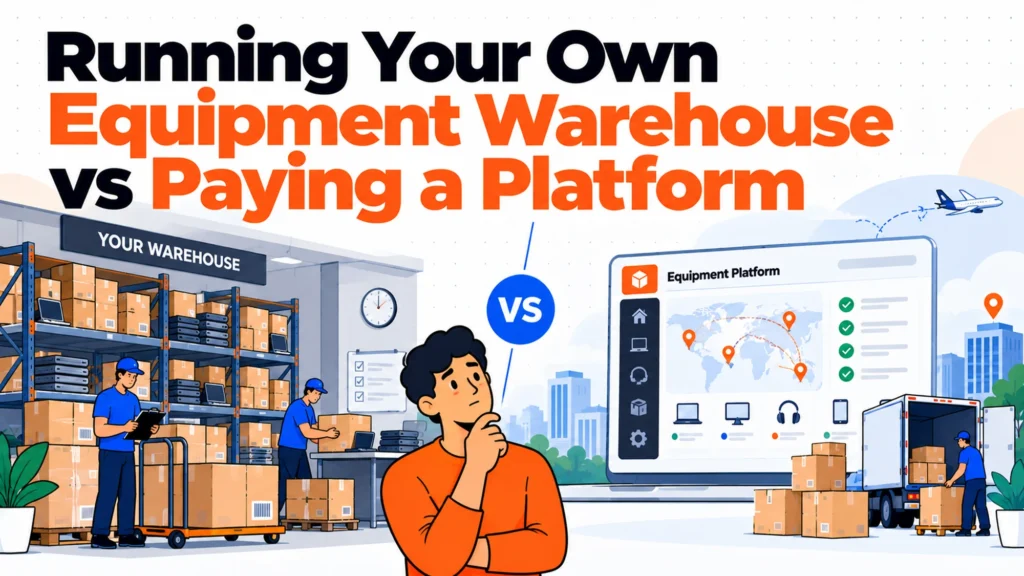
The short version. Holding your own stock looks cheaper than it is, because the comparison people build counts rent and ignores labour, shrinkage, obsolescence and the cost of the space being in one country. It is genuinely the right answer for a concentrated single-market company with steady volume and somebody who already does warehouse work. It is almost never right for a distributed one, because a warehouse in a country only helps the people in that country.
The comparison most companies build
Monthly storage cost against the platform fee. Storage wins, often by a lot, and the decision looks obvious.
That comparison is missing four costs, and together they usually reverse the answer for distributed companies. Each one is knowable in advance, which is why this is worth an hour before committing to a lease.
Cost one: somebody has to be there
Inventory does not receive, inspect, store, pick, pack and dispatch itself. Somebody opens boxes, checks serial numbers, decides whether a returned machine is reusable, keeps the count accurate and is physically present when a courier arrives.
In most companies that starts as part of somebody’s existing job and stays invisible until the volume grows. Count the hours honestly, use loaded cost rather than salary, and put the number in the comparison. It is frequently larger than the rent.
Cost two: the count drifts
Every self-managed inventory loses accuracy over time unless somebody is specifically accountable for it. Devices get taken for an urgent swap without being logged, returns get stacked without being received, and the number in the spreadsheet and the number on the shelf separate quietly.
The cost is not the missing devices, though there are usually some. It is that the count stops being trustworthy, which means every decision that depends on it needs a physical check first. A stock figure nobody believes is operationally the same as having no figure.
Cost three: stock loses value while it sits
A laptop held for eighteen months against possible future need is a depreciating asset you are paying rent on. The combination is worse than either effect alone, and it compounds quietly because nobody reviews stored inventory on a schedule.
The exception is a known need with a date. Thirty machines held for a confirmed intake next quarter is a sensible use of space. Thirty machines held because you might hire is paying for an option. The difference between those two positions is a date in a hiring plan, and it is worth writing that date down rather than carrying the intention in somebody’s head.
Cost four: a warehouse has a location
This is the one that decides it for distributed companies and it rarely appears in the spreadsheet at all.
Your warehouse is in one country. It serves the people in that country well and everybody else through international shipping, with the customs cost and the lead time that implies. If seventy per cent of your people are in that market, the arrangement is efficient. If they are spread across twelve countries, you have built a local solution to a distributed problem and you are paying to ship out of it constantly.
Platforms are not magic here either; they have locations too. The difference is that they have more of them and the cost of that distribution is spread across their customers rather than carried by you alone.
When in-house genuinely wins
Four conditions, and if you meet all four you should probably keep your own stock.
Your people are concentrated in one or two markets, so a local warehouse serves most of your volume directly.
Your volume is steady, so stock turns rather than sitting, and the holding period is short enough that depreciation does not dominate.
You already have suitable space and somebody whose job includes this kind of work, so the marginal cost is genuinely close to the rent.
And your device standard is uniform, which makes inspection and redeployment simple rather than a judgement call on every return.
The honest arithmetic to run
Rent plus labour hours at loaded cost plus an estimate of annual shrinkage plus depreciation on average held stock plus outbound shipping from your location to everywhere else. Against a platform quote built from the same specification.
Do not guess at the shrinkage figure. Count what went missing over the last two years from your own records, because an industry average invites an argument about whether it applies to you and your own number does not.
RemoAsset is our own product and that is the disclosure rather than a footnote. It covers procurement and retrieval across 80+ countries with a Subscription tier published from $1,499 a year. Its relevant limits here: it enrols devices but is not an MDM in its own right, it wipes devices but is not a certified ITAD, and coverage and lead times vary by market. For a concentrated single-market company with steady volume, your own shelf will usually beat any platform on cost and we would rather say that plainly.
How to decide
Build the five-line comparison above rather than the two-line one. It takes an afternoon and it frequently reverses the obvious answer.
Map your headcount against your warehouse location. If most of your people are not near it, the location cost is the whole decision.
Set a review date on any stored inventory, with a quantity and a reason, whichever route you take. Stock without a review date becomes a cost nobody owns.
Is holding our own stock cheaper than a platform?
On rent alone, usually yes, which is why the two-line comparison is so persuasive and so misleading. Add labour at loaded cost, annual shrinkage from your own records, depreciation on average held stock and outbound shipping from your single location to everywhere else, and the answer frequently reverses for distributed companies. For a concentrated company with steady turnover and existing space, in-house genuinely does win and the arithmetic will show that too.
What is the biggest cost people forget?
Location, because it does not look like a cost at all. A warehouse sits in one country and serves everyone else through international shipping with the customs exposure and lead time that implies. If most of your people are near it the arrangement is efficient; if they are spread across a dozen markets you have built a local answer to a distributed problem and are paying to ship out of it on every movement. Map headcount against warehouse location before anything else.
How do I estimate shrinkage?
From your own records over the last two years rather than from an industry figure. Count devices that were written off, replaced because nobody could locate the original, or recovered in a condition that made them unusable. Your own number is harder to dismiss in an internal discussion and more likely to be accurate for your situation, because loss rates vary enormously with company shape. If your own figure turns out to be small, leave it out of the argument entirely.
When does an inventory count stop being trustworthy?
Gradually, and usually without anybody noticing the moment. Devices get taken for urgent swaps without being logged, returns are stacked before being received, and the figure on the spreadsheet separates from the figure on the shelf. The real cost is not the missing units but that every decision depending on the count now needs a physical check first. A stock number nobody believes is operationally equivalent to having no number at all.
Should we store equipment for future hiring?
Only against a known need with a date attached. Thirty machines held for a confirmed intake next quarter is a sound use of space. Thirty held because hiring might resume is paying rent on a depreciating option, and the asset loses value every month it sits. Whichever route you take, put a quantity, a reason and a review date on any stored inventory, because stock without a review date becomes a recurring cost that nobody owns and nobody reconsiders.
Can we do both?
Yes, and it is often the right shape. Hold your own stock in the market where most of your people are and where volume justifies the space, and use a platform for the markets where you have no presence and no realistic way to hold inventory locally. The usual failure is ambiguity about which system is authoritative on device location, so decide that in the first month. Two records that both claim authority will disagree within a quarter.