TL;DR
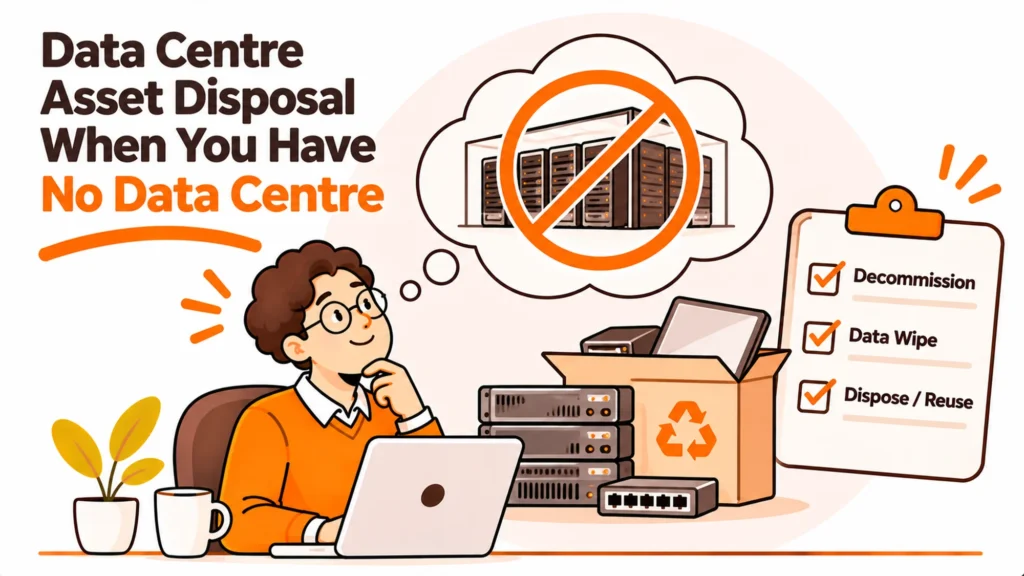
Most data center asset disposal guidance assumes a room you control, a rack you can point at and a loading bay. Distributed teams have none of those and inherit the rules anyway, usually through a security questionnaire. Some of it transfers cleanly. Some of it is actively misleading when the asset is a laptop in a flat three time zones away.
- The sanitisation rules transfer. The physical ones do not.
- Your highest risk asset is not in a rack.
- Decommissioning a server is scheduled. A laptop leaves unannounced.
- Serial reconciliation replaces the walk-the-rack check.
- Questionnaires still ask about secure facilities you do not have.
- Answer honestly and describe the control you do run.
What transfers cleanly
More than people expect, and it is the part worth keeping.
Sanitisation method does transfer. NIST Special Publication 800-88 on media sanitization is written for media rather than for rooms, and its clear, purge and destroy distinction applies identically to a drive in a server and a drive in a laptop.
Record keeping transfers. A decommission log with serials, dates, methods and outcomes is the same artefact whichever asset you are retiring.
Downstream responsibility transfers. The obligations described by the European Commission on waste electrical and electronic equipment and the guidance in the EPA guidance on electronics and battery management do not care whether the device was racked.
The useful consequence
If somebody hands you a data centre decommissioning policy and asks you to comply, about half of it is already the right answer. Do not throw it out because the first paragraph mentions a cage.
What does not transfer, and misleads
Three things, and the third causes real damage.
Physical access control. A policy clause about badge access to the disposal area assumes a disposal area. Your equivalent control is the courier and the processor’s dock, which is a different control with different evidence.
Scheduled decommissioning. Servers retire on a plan. Laptops leave when a person resigns, which can be the same afternoon. A process designed around a change window will not fire at all.
The assumption of possession. This is the dangerous one. Data centre disposal starts from the premise that you have the asset. Distributed disposal starts from the premise that you do not, and getting it back is the hard part. what a certificate of destruction actually covers covers what the resulting paperwork does and does not say.
Why that inversion matters
Every control downstream of possession is well understood and widely available. The control upstream of it, getting a laptop out of a flat in another country, is where programmes actually fail.
Where the risk actually sits now
Count the drives. For most companies under a few hundred people, there is no rack, and the sensitive data sits on endpoints.
That inverts the old risk model. The highest value target used to be concentrated and guarded. Now it is distributed, in homes, and frequently unaccounted for at the moment somebody leaves.
| Question | Data centre answer | Distributed answer |
|---|---|---|
| Where is the asset? | Rack and unit | Last known address |
| Who has access? | Badge list | One person, unsupervised |
| When does it retire? | Scheduled | On resignation |
| How do you verify? | Walk the rack | Reconcile serials |
| Main failure mode | Missed drive | Device never returned |
The last row is the whole argument. RemoAsset’s laptop retrieval service for remote teams addresses the distributed column directly, and our explainer on ITAD and recycling covers what happens once the device is actually in hand.
Answering the questionnaire honestly
Sooner or later a customer or an insurer sends a security questionnaire written for a company with a server room.
Three questions recur. Do you maintain a secure disposal area? Is physical access logged? Are decommissions scheduled and approved?
The wrong answers are “yes” stretched to fit, and “not applicable” with nothing after it. Both read badly and the first is worse, because it invites a follow up you cannot evidence.
The answer that works describes the control you actually run. Devices are collected by a tracked and insured courier. Serials are scanned on receipt. Sanitisation is performed to a named standard with per-device outcomes. Discrepancies are reported within a fixed window.
the NCSC device security guidance is a reasonable reference to cite, because it is written for modern endpoints rather than for racks.
If you do still have servers somewhere
Plenty of companies have a handful, and they get forgotten precisely because they are not the main story any more.
The usual suspects: a NAS in a cupboard at the old office, a machine under a desk running something nobody has migrated, test hardware from a project that ended, and whatever is in the rack at a colocation facility nobody has visited since the move to cloud.
Those carry the highest data concentration you own and the weakest process. They are also the easiest thing in this article to fix, because there are so few of them.
A one afternoon exercise
- List every machine that is not a laptop or a phone.
- Name an owner for each.
- Record whether it holds data and whether it is backed up.
- Decide retire, migrate or keep, and put a date on retire.
Most teams find between two and six. Almost all of them should have gone already.
What a workable programme looks like
Four parts, and only one of them is disposal.
Know what you own. A register that is reconciled rather than maintained from memory. ISO 55001 on asset management is the framing worth borrowing.
Get it back. A retrieval route that triggers on the leaver event rather than on somebody remembering.
Sanitise and evidence. A named method, per-device outcomes, a discrepancy window.
Dispose responsibly. A certified processor with named downstream vendors.
Written that way it is obvious where the effort goes, and it is not the fourth item. RemoAsset’s laptop lifecycle management service covers the whole chain, which is the useful shape when the pieces keep being bought separately.
When the old guidance is still right
If you run regulated workloads on hardware you own, the data centre playbook applies as written and this article is the wrong one. The distributed version is for everybody whose server room became a cupboard and then became nothing.
The transition nobody documented
Most companies did not decide to stop having a data centre. They moved workloads to cloud one service at a time, and at some point the room stopped mattering without anybody declaring it.
The policies did not move at the same pace. So you end up with a disposal standard describing a facility that was given up two years ago, and no standard at all for the four hundred endpoints that replaced it.
That mismatch is worth naming explicitly when you rewrite. Say which parts of the old policy are retained, which are retired, and what replaced them. A reviewer who can see the mapping will accept it quickly. One handed a fresh document with no lineage will ask why the old controls disappeared, and that conversation takes far longer than writing the mapping would have.
Keep the mapping to one page. Three columns are enough: the old control, whether it is retained, retired or replaced, and the current equivalent. Anything longer stops being read and starts being filed.
Do the rewrite when a questionnaire forces it rather than on a planned date. That sounds like poor practice and it is the pattern that actually produces a document, because the deadline is external and somebody senior is already asking.
The version written during a customer review also gets tested immediately, which is the fastest way to find the clauses that sound fine and cannot be evidenced. A policy rewritten quietly in a planning week tends to go unread until the review happens anyway, and then it fails the same test later with more at stake.
[Two-CTA block: Case Studies | Talk to Expert]
Frequently asked questions
Does data center asset disposal guidance apply to laptops?
About half of it does, and the half that transfers is worth keeping. Sanitisation method transfers cleanly, because the recognised standards are written for media rather than for rooms. Record keeping transfers, since a decommission log with serials, dates, methods and outcomes is the same artefact either way. Downstream responsibility transfers too. What does not transfer is anything assuming a controlled physical space or a scheduled change window.
What is the most misleading part to carry across?
The assumption that you have the asset. Data centre disposal starts from the premise that the device is in your building and the work is to retire it safely. Distributed disposal starts from the premise that the device is in somebody’s flat and getting it back is the hard part. Every control downstream of possession is well understood and widely available. The control upstream of it is where programmes actually fail.
How do I answer a security questionnaire written for a server room?
Describe the control you actually run rather than stretching a yes or writing not applicable with nothing after it. Devices are collected by a tracked and insured courier, serials are scanned on receipt, sanitisation is performed to a named standard with per-device outcomes, and discrepancies are reported within a fixed window. That answers the intent of the question, which is whether the asset is controlled, and it is evidenced.
We still have a few servers. What should we do with them?
Find them first, because they get forgotten precisely because they are no longer the main story. The usual suspects are a NAS in a cupboard at the old office, a machine under a desk running something nobody migrated, leftover test hardware, and whatever sits in a colocation rack nobody has visited since the cloud move. They carry your highest data concentration and your weakest process, and most teams find only two to six of them.
What replaces walking the rack as a verification step?
Serial reconciliation. Compare devices recorded as leaving the business in the period against devices received by the processor by serial, against devices still in storage by serial, and name what remains. The remainder is the only figure that matters. It is a duller check than a physical inspection and it is the only one available when the assets are in two hundred homes rather than forty racks.
Is a certified processor necessary for a small fleet?
It depends less on fleet size than on whether your own records would be believed without one. With no regulated data, a small number of devices a year and somebody in house who can verify a wipe, it is a reasonable expense rather than a required one. If your records are already contested internally, or a customer questionnaire asks for third party evidence, the certificate is doing a job your own log cannot.
Where should the budget actually go?
Into getting devices back, not into disposal. Disposal is a mature, competitive service and the quality difference between a good vendor and an adequate one is small. Retrieval is where the loss happens, because a laptop that never returns is both a data risk and a written off asset, and no disposal contract can recover either. If you only fund one part of this chain, fund the part that puts the device in a box.
[Start for free]